Short answer: No, you do not need a subscription to use Logos Bible Software.
Logos is still worth using without one, and it remains one of the strongest Bible study tools available. The subscription adds valuable new tools, especially AI and cloud-based features, but it does not replace everything Logos already offers.
Logos promised that users will never be forced to subscribe. Even if someone last bought a Logos feature set many years ago, they can keep using what they purchased and continue receiving app updates and bug fixes. Books and libraries purchased separately also remain yours permanently; cancelling a subscription only removes access to subscription-included books and subscription-only tools.
Logos Is Already Useful for Free
A good place to start is the free Logos app. This is not just a limited demo. The free version includes a small library of Bibles, interlinears, commentaries, dictionaries, and basic study tools. The free edition currently includes 25+ digital resources, including English Bibles, study resources, interlinears, datasets, Factbook-related features, Bible Word Study panel linking, workflows, notes, search tools, and more. Logos is also offering many more free Recourses.
For basic Bible reading, devotional study, sermon preparation beginnings, Passage Guide-style study, Factbook exploration, and word studies, the free Logos version already goes very far. Even without paid upgrades, it is one of the strongest free Bible software options available.
The Real Strength of Logos: Integrated Resources
The greatest strength of Logos is not only the software itself, but the way it connects your theological library.
A commentary, lexicon, Bible dictionary, systematic theology, journal, or church history book in Logos is not just a digital book. It is connected to Bible passages, topics, original-language data, cross-references, guides, searches, and other tools. When you study a passage, Logos can surface relevant content from your own library instead of making you search every book manually.
That is also why Logos can become expensive. The most valuable part is often the resources. But the same commentaries, dictionaries, and theological works would usually not be cheaper in print—and in Logos they are much easier to search and use.
This is also why I created this page and the Theodeals Logos Price Tracker: it helps you evaluate sales, compare bundles, find cheaper ways to buy resources, and avoid missing coupon codes.
What Changed with Subscriptions?
The newer Logos model separates three things:
- The free Logos app
- Books and libraries you can buy and own permanently
- Subscription features, especially newer AI and cloud-based tools
So the question is not really, “Do I need a subscription to use Logos?” The better question is:
Do the newer tools save me enough time to be worth the subscription?
For many users, especially those with larger libraries, the answer may be yes. AI-assisted searching and Research Assistant-style tools can make a big library much easier to use. Instead of only searching for exact words, you can ask broader questions and let Logos help surface relevant material from your books.
Logos Subscription Plans Compared
Current Logos subscriptions are grouped into Premium, Pro, and Max. Logos lists the plans as follows: Premium for small group leaders and in-depth study, Pro for pastors and sermon prep, and Max for language study and research. Annual billing saves about 16%, and Logos also offers a two-year option described as “pay for 2 years and get 2 months free.”
| Plan | Monthly | Yearly | 2 Years | Best For | Main Value |
|---|---|---|---|---|---|
| Premium | $9.99/mo | $99.99/year (pay 2 month less) | $189.99 (pay 5 month less) | Small group leaders, personal study, users wanting a stronger Logos experience | Verse insights, curated library search, discussion questions, core new tools |
| Pro | $14.99/mo | $149.99/year (pay 2 month less) | $284.99 (pay 5 month less) | Pastors, teachers, sermon preparation, serious Bible students | Sermon planning, deeper insights, Greek and Hebrew study, stronger AI/search workflows |
| Max | $19.99/mo | $199.99/year (pay 2 month less) | $379.99 (pay 5 month less) | Seminary students, researchers, academics, original-language users | Advanced original-language tools, grammar and syntax study, research and writing support |
All subscription tiers include extra subscriber benefits, such as an additional 5% storewide discount, an extra free book each month, and plan-based Mobile Ed course access. Pro and Max also include Logos Sermons access and an annual reward coupon program.
If you never used a subscription you would get the first 60 days as a free trial when starting it over a partner link like ours:
Which Logos Option Should You Choose?
Simple Recommendation
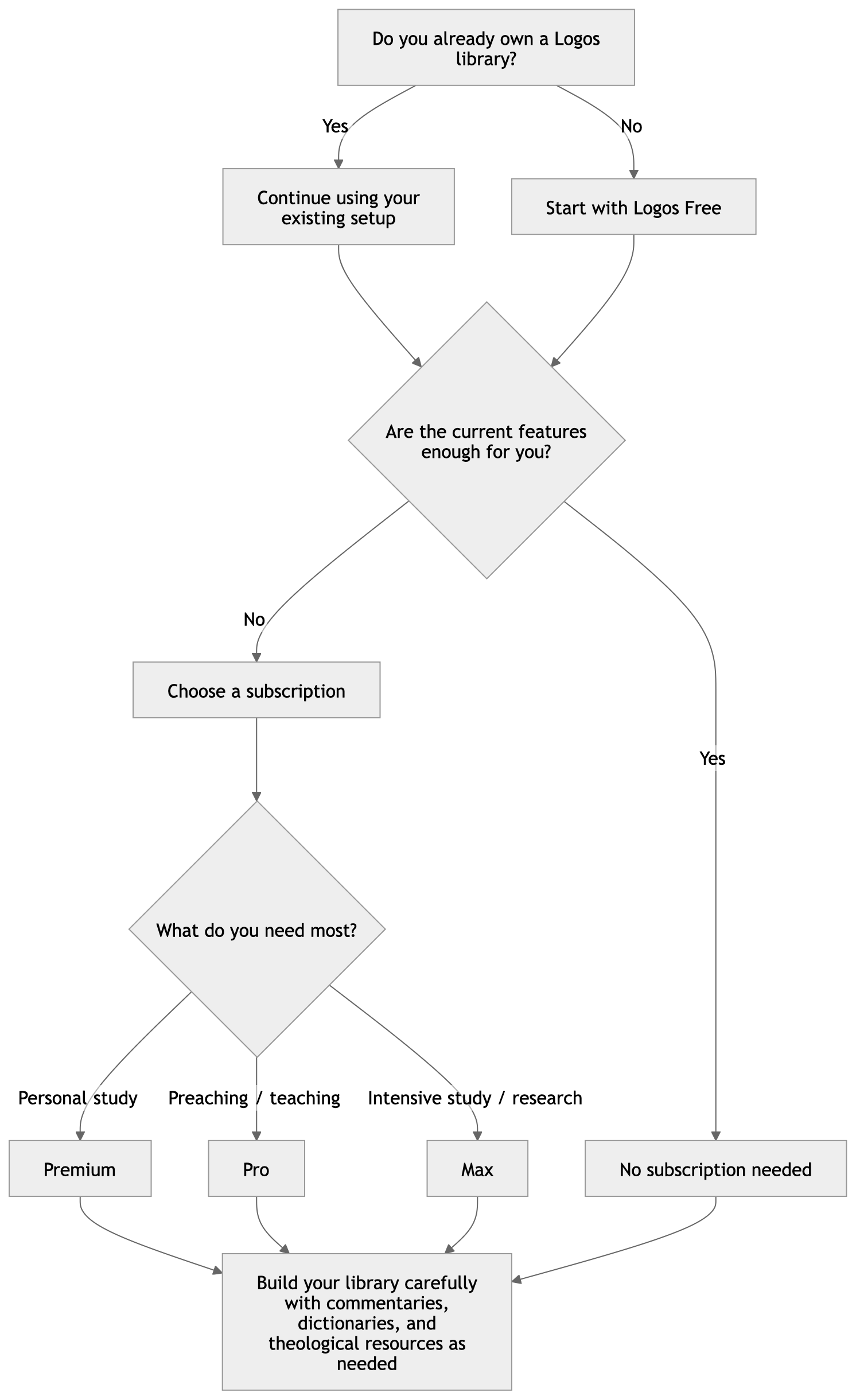
If you are new to Logos, start with the free version first. It already offers a serious Bible study environment and helps you see whether Logos fits your workflow.
If you mainly want better books, invest in resources carefully and use sales wisely. This is where Logos becomes most powerful, and Theodeals can help you avoid overpaying.
If you already have a large Logos library, a subscription becomes more attractive. The AI and research tools can help you actually use the books you already own instead of letting them sit unused.
For most regular users who decide to subscribe, Premium is the easiest entry point. For pastors, teachers, and serious students, Pro will often be the best value. Max is mainly for those doing deeper research, academic work, or regular original-language study. If unsure it is not a big problem to choose the wrong level, even if you paid for two years Logos will always reapply everything that you paid already to the new subscription, no matter if you downgrade or if you upgrade, you would not lose what you have prepaid already.
Conclusion
You do not need to subscribe to Logos. Existing Logos owners keep what they bought, and the free version is already a very strong Bible study tool.
But the subscription can still be worth it. It makes Logos more accessible, adds modern AI-assisted tools, and can save a lot of time—especially if your library is large. The best strategy is to start small, buy resources wisely, and subscribe only when the added tools clearly improve your study.