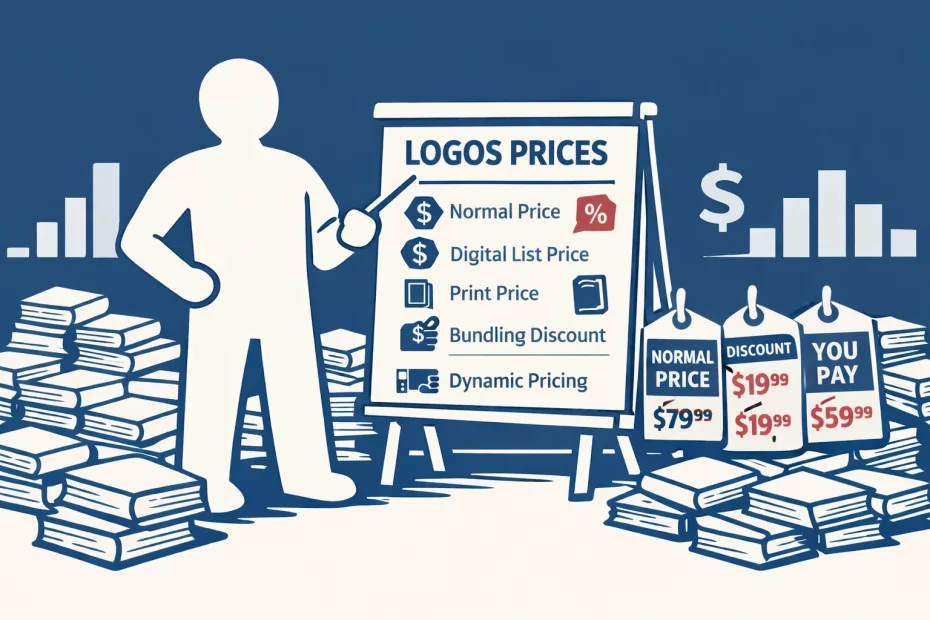
Logos pricing can be surprisingly confusing—even for experienced users. Different pages show different price labels, some prices are purely theoretical, and collections introduce additional layers like dynamic pricing and bundling discounts.
This post explains all price types you will encounter on Logos, what they actually mean, and which ones matter when deciding whether something is a good deal.
1. Single Products: The Easy Case (Mostly)
The black price
If a product page shows one black price, this is the simplest and clearest case:
- This is the normal Logos price
- This is what you pay if the product is not discounted
Digital List Price
Some products also show a Digital List Price.
Important facts:
- This is not a price you ever pay on Logos
- It does not represent the typical market price
- It is mainly used as a marketing comparison, roughly intended to resemble an ebook (PDF/EPUB) list price on a publisher’s website
- Even Amazon Kindle and other ebook stores are often cheaper than Logos’ Digital List Price
Conclusion:
Digital List Price is not a meaningful comparison for real-world Logos purchases.
Print Price
Some Logos product pages show a Print Price, representing the estimated cost of the physical book.
However, in practice:
- It is not a Logos price
- You cannot buy the print book through Logos
- It is not used for:
- Sales discounts
- Dynamic pricing
- DPS calculations
- Collection value
- It does not affect what you pay in any way
Just like Digital List Price, it functions primarily as a comparison anchor, not as a real price within the Logos ecosystem.
Regular Price (on discounted products)
If a product is discounted, Logos shows a Regular Price:
- This is the true Logos baseline price
- This is what you would pay when the product is not on sale
- All discounts are calculated from this price
This is a price you can actually use for comparison.
“Everyday savings”
Sometimes, when you hover over the sale price, Logos shows “Everyday savings.”
For single products, this usually represents:
- Digital List Price minus regular Logos price
Since the Digital List Price is mostly irrelevant, these “savings” are not real savings in any practical sense.
2. Collections: Where Things Get Complicated
Collections introduce several additional price layers.
Regular Collection Price
This is:
- The price you pay for the collection when it is not on sale
- The correct baseline price for that collection
Digital List Price (Collections)
Collections can also show a Digital List Price:
- Just like with single products, this price is mostly meaningless
- It does not represent what you would ever realistically pay
Collection Value / Full Collection Value
This is one of the most important numbers on a collection page.
Collection Value means:
- The total price you would pay if you bought every included resource individually
- At regular individual Logos prices
- With no discounts
This value is the basis for Dynamic Price Strength (DPS).
Dynamic Price Strength (DPS)
Dynamic Price Strength (DPS) expresses how aggressively a collection is discounted compared to buying all included items individually.
Important: DPS is not shown on the Logos website. It is a concept you can observe and track using the Logos Price History Tool.
Because of DPS:
- Large collections can save 80–95% compared to buying the resources one by one
- These savings exist even when the collection is not on sale
This is why some collections are excellent investments, even if they “never go on sale.”
Example: Craig Keener Study Bundle L
This collection includes:
- Full New International Commentary
- Tyndale Commentaries
- The New American Commentary
- IVP Bible Dictionaries
- Additional high-value commentaries and resources
The collection costs less than the NICOT series alone, despite containing far more material.
Since NIC commentaries are among the best evangelical exegetical commentaries available, this collection is an outstanding value and easy to recommend to anyone who wants some of the best Logos has to offer at a very low effective price.
Bundling Discount
Sometimes Logos explicitly mentions a Bundling Discount.
This is simply:
- Collection Value minus Regular Collection Price
It reflects the built-in discount of the bundle.
3. Dynamic Pricing: “Discounts for products you own”
Collections may show:
“Discounts for products you own”
This is dynamic pricing.
Key points:
- The discount is not based on what you paid
- It is based on the regular Logos price of the resources you already own
- It is scaled by the DPS of the collection
Example
- You own two IVP Bible Dictionaries
- Each normally costs $49.99 → $99.98 total
- The collection has a DPS of 90%
Because of DPS:
- With 90% DPS each $10 of collection value is treated as $1
- Your ownership discount is about $10, not $99.98
Regular Dynamic Price
Your Regular Dynamic Price is:
- Regular Collection Price
- minus “Discounts for products you own”
This is your personal baseline price.
Sale Discounts
If the collection is on sale:
- The red percentage discount applies after dynamic pricing
- Example: 20% off means 20% off your dynamic price, not the list price
4. Pre-Pub Pricing: A Category of Its Own
Pre-Pub pricing adds yet another layer of confusion.
Comparison prices on Pre-Pubs
Pre-Pubs are sometimes compared against:
- “Digital collection listing price”
- “Digital listing prices”
- “print price”
These prices can be extremely high and usually do not reflect anything you would ever pay on Logos.
Regular Price on late-stage Pre-Pubs
If a Pre-Pub is far along, Logos may already show a Regular Price:
- This is the price the product will have after release
- This is a meaningful comparison point
DPS and price history
Because Pre-Pub pricing is inconsistent:
- The Price History Tool does not calculate DPS for Pre-Pubs
- Even though DPS would be the best indicator of long-term value
Best strategy for Pre-Pubs
- Preorder resources you are interested in
- Shortly before release, Logos sends a notice
- At that point, compare the Pre-Pub price to the now-fixed Regular Price
- Decide whether to keep or cancel
For niche products unlikely to appear in collections, Pre-Pub pricing can be very attractive.
5. One Final Important Detail: Currency and Payment
All Logos prices are charged in USD.
Even if:
- Your interface is localized
- Logos shows an estimated price in another currency
You will still be charged USD.
Depending on your bank or credit card provider:
- You may pay a small currency conversion fee
- The final amount may differ slightly from the displayed estimate
Summary
If you take only one thing away from this:
- Ignore Digital List Prices
- Focus on Regular Prices, Collection Value, DPS, Dynamic Price, and Sale Discounts
Once you understand these concepts, Logos pricing stops being mysterious—and you can spot genuinely great deals with confidence.